Tennis
Fiona Tesfamariam
About
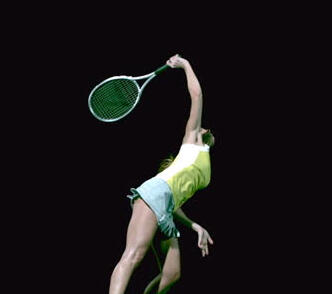
Tennis is an Olympic racket sport that can be played by anyone who can hold a racket. It is played individually against a single opponent, (classified as singles), or between two different teams of two players each (doubles). The game comes from Birmingham, England, 19th century, once known as lawn tennis. The ultimate aim of the game, is to handle the ball in such a way that the opponent is unable to return a valid shot. If the player can’t return the ball, points is given to the opponent. To be specific, since tennis is an individual sport, there’s no positions, but they are usually grouped in three different categories such as: baseliners, serve-and-volley players, and all-court players. While playing tennis, there’s many different tactics and strategies that players often use. Some popular tactics are, attacking the middle, moving side to side at the net and hitting groundstrokes deep in the court.
Rules
The general rules of this sport are:
A ball must land within bounds for play to continue; if a player hits the ball outside of bounds, this results in the loss of the point for them.Players/teams cannot touch the net or posts or cross onto the opponent’s side.Players/teams cannot carry the ball or catch it with the racquet.Players cannot hit the ball twice.Players must wait until the ball passes the net before they can return it.A player that does not return a live ball before it bounces twice loses the point.If the ball hits or touches the players, that counts as a penalty.If the racquet leaves the hand or verbal abuse occurs, a penalty is given.Any ball that bounces on the lines of boundary are considered good.A serve must bounce first before the receiving player can return it.
Diagram
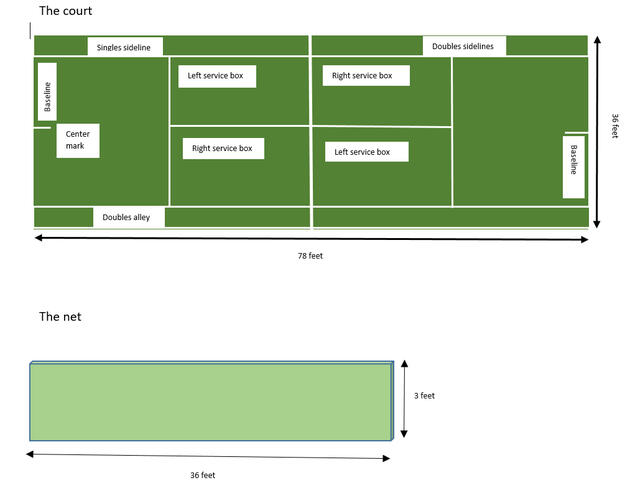
Above is a clear representation of a tennis court.
Key components
Tennis is quite unique compared to other sports, requiring almost all key fitness components to be successful such as, power, agility, speed, flexibility, reaction time, balance, coordination, cardiovascular endurance and muscular endurance. Without these mastering these skills, playing tennis isn't the quite easiest.
2 Week Tennis Training Program
The ultimate aim of this program is to help improve and build the skills and fitness components required for a beginner tennis player. The major fitness components that this programs focuses on is aerobic power, hand eye coordination and muscular endurance. Partaking in this fantastic program without a doubt build my player’s skills in this sport.
On Monday, the 2 Week Training Program begins with a 10-20 minutes Beep test. Beep tests are great for building the player’s aerobic power at the start of the program. After the Beep test, players perform simple forehand and backhands hits, focusing on improving their technique and hand eye coordination.
On the second day of the program, a light jog going for at least 7 minutes begins the lesson, improving aerobic power. After the jog, players do both the frying pan and dribble drill. These drills both go for 15 minutes each, helping with hand eye coordination.
On Wednesday, it is a rest day and is more focused on light stretches for 15 minutes. Supine glute wall stretch, wall back twist, and side lying quad stretches are examples for stretches players can use for this rest day.
On Thursday, this drill focuses on ball toss forehands and backhands going for at least twenty minutes. This drill focuses on hand eye coordination.
On Friday, the drill is quite similar from Thursday, however, drills are to do simple forehands and backhands, and ball toss forehands and backhands each for fifteen minutes. These drills focus on improving hand eye coordination skills.
On Saturday, the drills consist of a ten minute jog (for aerobic power), and stretches going for 20 minutes that help with muscular endurance. This stretches include: split pose, star pointer and ace pose.
On Sunday, it is another rest day. This day focuses on flexibility, so therefore giving a 20 minutes drill of yoga.
On the second Monday, the running the lines drill and frying pan drill go for twenty minutes in total. They both help with warming up hand eye coordination.
On Tuesday, the drills consist of simple service motions, toss and block volleys and split step volleys. Each of these drills go for about ten minutes, helping improve hand eye coordination and serving skills in tennis.
On Wednesday, there is a rest day. A drill of yoga goes for 15 minutes, helping with flexibility.
On Thursday, a light jog goes for ten minutes, which focuses on improving aerobic power and a drill of serve toss accuracy going for 15 minutes.
On Friday, the drills are simple forehands and backhands, going for 15 minutes. This drill is great for building hand eye coordination skills.
On Saturday it is a rest day.
On the last day of the program, Sunday, drills consist of running the lines, and stretches to help with muscular endurance. Some of these exercises include foam rolling and knee hugs. These drills go for 20 minutes, helping flexibility.